AI suggests, the translator decides

The power of a second language
6 May 2025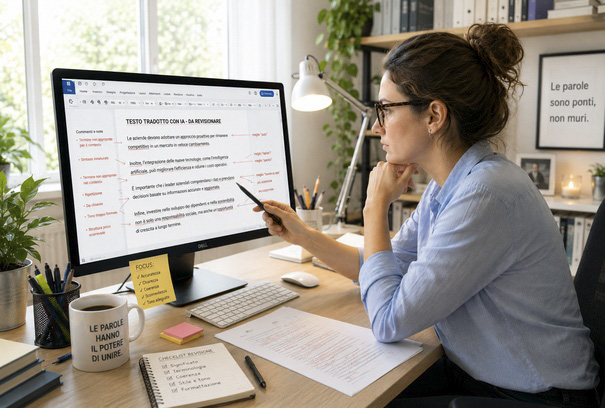
AI is rapidly changing the way we work and communicate. The translation industry is no exception: today, AI-powered tools can translate texts that, only a few years ago, would have required hours of work.
But does this mean that we can now fully entrust a professional translation to Artificial Intelligence? The answer, at least for now, is no.
Translation does not simply mean replacing one word with another
Professional translation is not simply about automatically converting a text from one language into another. A sentence can be grammatically correct and, at the same time, sound unnatural, be ambiguous or convey a completely different meaning from the original.
The meaning of a word depends on the context, the industry in which it is used, the audience it addresses and, often, the culture of the target country. A technical term, for example, may have one translation in the medical field and a completely different one in a legal or commercial context. An idiomatic expression may have no direct equivalent in another language. An advertising message, on the other hand, may need to be completely rewritten to achieve the same effect on a foreign audience.
AI has certainly become quite effective at processing language. However, fully understanding the communicative intention behind a text, whatever its nature, still requires expertise, experience and the ability to interpret.
The risk of errors that look correct
One of the most insidious aspects of AI-generated translations is that errors are not always obvious. A text may appear perfectly fluent and natural, yet contain an incorrect term, altered information or a subtle nuance that changes the original meaning and overall message. This is particularly sensitive when translating technical, medical, legal or financial documents, where even a small inaccuracy can have significant consequences.
But the issue can also affect corporate communication. A website, brochure or presentation represents a brand to an international audience. A translation that is formally correct but sounds unnatural or is culturally inappropriate can convey an unprofessional image of the company.
The risk, therefore, is not simply making a linguistic mistake, but compromising communication.
AI is a tool, not the translator
This does not mean that Artificial Intelligence is not useful in the translation process. It can be an effective tool for speeding up certain stages of the process, comparing possible formulations, identifying potential terminology and handling large volumes of text.
The key distinction, however, is between using AI as a tool and fully entrusting a professional translation to AI. In the first case, AI can help a professional work more efficiently. In the second, the result depends on the system’s ability to correctly interpret the text as a whole. Even when the resulting text appears correct, it is not always possible to be certain that the original intention, tone, terminology and meaning have been fully preserved.
The added value of a professional translator
A professional translator does not simply check whether the words are correct. They read, interpret, verify and adapt. They understand both the source and target languages, but, more importantly, they understand the context in which the text will be used. They know when a literal translation is appropriate and when, instead, a sentence should be completely rephrased. They can recognise ambiguous terms, identify cultural references and choose the most appropriate terminology for a specific industry.
The best solution? Technology and human expertise together
The evolution of Artificial Intelligence will undoubtedly continue to transform the translation industry. AI tools will probably become increasingly accurate, faster and more capable of understanding natural language.
But, at least today, the most effective way to achieve high-quality professional translation remains the combination of technology and human expertise. The professional translator remains the person who ensures that the final text is accurate, consistent, properly contextualised and genuinely effective for its intended audience. Human expertise is still essential!
Note: The image accompanying this article was generated using AI.