The Navajo code

Languages without numbers or with unique numerical systems
1 April 2025
Hangul: the Korean alphabet
17 April 2025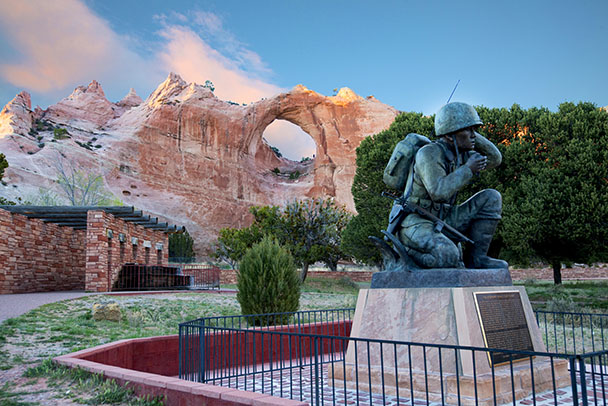
The Navajo Code: the secret language that changed the course of the War
During World War II, the United States discovered an unexpected secret weapon: the Navajo language. This complex and little-known Indigenous language became the foundation for an unbreakable military code used in secret communications across the Pacific. Thanks to the Navajo “Code Talkers,” the US Marines were able to transmit orders and information without fear of enemy interception. Here’s the story behind this extraordinary achievement.
Why Navajo?
The choice of Navajo as the basis for the secret code was no coincidence. It is an isolated language, unrelated to other known languages, and, at the time, there were no accessible written records or dictionaries. Its grammar and phonetics were also highly complex, making it incomprehensible to anyone who wasn’t a native speaker.
Philip Johnston, a World War I veteran and the son of a missionary who had lived among the Navajo people, proposed the idea to the U.S. military. Having learned Navajo as a child, he recognized its potential as a secure code.
Creating the Code
In 1942, 29 young Navajo men were recruited by the Marines to develop a code based on their language. The goal wasn’t just to translate messages into Navajo language, but to build a structured, indecipherable system. To prevent the enemy from understanding key military terms, they used coded expressions:
| Military Term | Code Term | Navajo Translation |
| Tank | Turtle | chay-da-gahi |
| Fighter Plane | Hummingbird | da-he-tih-hi |
| Airplane | Iron Bird | tas-chizzie |
| Spy Plane | Owl | ne-as-jah |
| Bomber | Buzzard | jay-sho |
| Battleship | Whale | lo-tso |
| Submarine | Iron Fish | besh-lo |
| Minesweeper | Beaver | cha |
If a word had no direct Navajo equivalent, Code Talkers would break it into syllables and use Navajo words that matched those sounds to form a new encrypted term.
On the Battlefield
The Navajo Code Talkers were first deployed at the Battle of Guadalcanal and continued to serve throughout the war, proving crucial in key operations such as the Battle of Iwo Jima. During those critical days, six Navajo Code Talkers worked non-stop for 48 hours, transmitting over 800 error-free messages. General Howard Connor, head of communications for the 5th Marine Division, stated: “Were it not for the Navajos, the Marines would never have taken Iwo Jima.”
Unlike other codes, the Navajo code was never broken. Even if a Japanese soldier intercepted a message, without knowledge of the language and encoding system, its meaning remained impenetrable.
Secrecy and Late Recognition
Despite their vital role in the war, the Navajo Code Talkers remained in the shadows for many years. The program was so secret that even fellow Marines were often unaware of their identity. It wasn’t until 1968 that the U.S. government declassified the project, allowing the world to learn of their contribution. In 2001, President George W. Bush awarded the Congressional Gold Medal to the few surviving Navajo Code Talkers, finally recognizing their sacrifice and bravery.
The Legacy of the Code Talkers
Today, the contributions of the Navajo Code Talkers are honored through museums, documentaries, and films like Windtalkers. Their work highlighted the value of Indigenous languages not only as cultural expressions but also as strategic tools in military history.
The Navajo Code remains the only military code never to be deciphered — a true testament to human ingenuity and the linguistic richness of Native American peoples.
👉 Want to explore the Navajo Code? Here it is: Navajo Code Talker Dictionary
Note: The photo at the top of the article shows the Navajo Code Talker Memorial at Window Rock Navajo Tribal Park & Veteran’s Memorial in Window Rock, Arizona. Photo by John Fowler, sourced from Flickr.